

Slide&Hide ovens are popular because the door disappears beneath the oven cavity, creating easier access to food and saving space in front of the appliance. The same design, however, creates a cleaning problem that is easy to overlook: splashes, crumbs and grease can travel into edges and channels that are difficult to reach during an ordinary wipe-down.
The front glass may look clean while the lower door area still holds baked-on residue. This is one reason Slide&Hide ovens need a more considered approach than a conventional drop-down door.
Why the hidden door collects contamination
When an oven door is open, condensation and grease can run towards its lower edge. Food crumbs may also fall from trays or cookware as they are removed. On a standard oven, much of this contamination remains
 visible around the hinges and door frame.
With a retracting door, some of it can be carried towards the space below the cavity. Regular use then adds new layers before the earlier residue has been noticed.
Signs that the less visible areas need attention can include:
- A greasy line along the door edge
- Crumbs appearing when the door moves
- Sticky marks near the lower frame
- Brown streaks that return after the visible glass is wiped
- Grease or condensation trapped between glass panels
- An unpleasant hot-grease smell despite cleaning the cavity
These symptoms do not necessarily mean there is a mechanical fault, but they are good reasons to inspect the appliance carefully.
The niche problem: access changes as the door moves
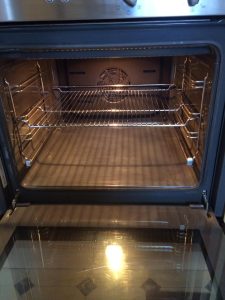
A Slide&Hide door presents different surfaces depending on whether it is closed, partly open or fully retracted. A section that appears accessible in one position may sit close to moving components in another.
That makes improvised dismantling risky. Forcing trim, removing screws without knowing their purpose or allowing liquid to run into the mechanism can create a much bigger problem than the original grease mark.
The manufacturer’s manual should always be the starting point for routine owner maintenance. If the glass or concealed areas require disassembly beyond the stated user procedure, professional help is the sensible option.
Why grease between the glass cannot be wiped away
Oven doors often contain more than one glass panel. If grease enters the space between them, cleaning the inside and outside faces will not reach it. The mark may appear to be on the cavity side when it is actually sealed behind another pane.
Accessing this area can require the door or glass assembly to be split. Clips, fixings, spacers and the order of the panels must be handled correctly so the door can be reassembled as designed.
OvenKing lists a separate charge where an oven door needs to be split for cleaning, with the scope and cost discussed before the work is completed. Slide&Hide ovens also carry a specific surcharge because of the additional work involved. You can see the current details on the OvenKing pricing page.
What a professional oven clean addresses
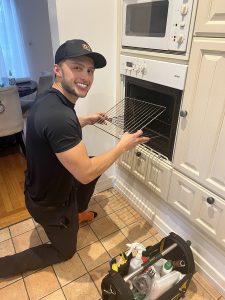
A professional clean is not limited to wiping the visible cavity. OvenKing’s domestic process includes removing racks, trays, fan plates and bulb covers so suitable components can be treated separately. The technician can then work carefully around the cavity, door and accessible framework.
For a Slide&Hide model, the exact method depends on the appliance and its condition. The aim is to clean thoroughly without treating every oven as though its construction were identical.
Keeping the hidden area cleaner between visits
A few habits can slow down the build-up:
- Wipe fresh splashes once the oven is safely cool
- Use trays that are deep enough for fatty foods
- Avoid overfilling roasting dishes
- Remove loose crumbs rather than pushing them towards the door gap
- Clean the door edges as well as the centre of the glass
- Check the manual before removing glass or trim
Do not flood the lower door area with cleaning solution. More liquid does not necessarily mean more cleaning, particularly around a retracting mechanism.
Book a clean designed for your appliance
If the visible surfaces are clean but grease remains around the retracting door or between the glass, repeated surface wiping will not solve the underlying access problem.
OvenKing’s trained technicians clean Slide&Hide ovens across Dorset, Hampshire and surrounding areas. The team also carries a selection of common replacement items, including bulbs, filters and door seals, where appropriate.
Request a quick quote or book your oven clean and mention that your appliance has a Slide&Hide door. This allows the team to price and plan the appointment correctly.

